
Common causes of concrete damage & how to mitigate them
- High-grade concrete without heat-of-hydration treatment is prone to thermal cracking.
- Marine concrete without watertightness treatment is prone to corrosion & spalling.
→ Bioconc is an integral solution to both risks.
Mitigate thermal cracking by reducing cement content with Bioconc. The mycelia produced by Bioconc act as a microfiller, inserting into the cement paste to fill micropores, or reducing cement content, while the target concrete grade is still achieved. Cement is both the largest CO₂ emitter and the largest production cost in a concrete mix. Nanotechnology that reduces cement use in concrete, Green Concrete Technology, delivers lower concrete production costs and reduced CO₂ emissions.
More cement means more heat of hydration. In mass concreting, a temperature gap of more than 20°C between core and surface triggers thermal cracks. Bioconc treatment is therefore needed to reduce cement, which automatically reduces the heat of hydration and avoids potential thermal cracking.
Bioconc mitigates shrinkage cracking, preventing potential rebar corrosion. Without shrinkage-crack mitigation, hairline cracks can form that let oxygen and water penetrate the concrete down to the rebar, causing corrosion that reduces the durability and service life of the concrete.
Bioconc reduces the cement content of a concrete mix by up to 35%, which means lower construction costs.
Bioconc_09 increases concrete watertightness. A DIN EN 12390-8:2009-07 watertightness test at the Universitas Indonesia Construction Laboratory measured 15.8 mm water penetration ≪ 25 mm, meeting the watertightness requirement (see brochure ↗).
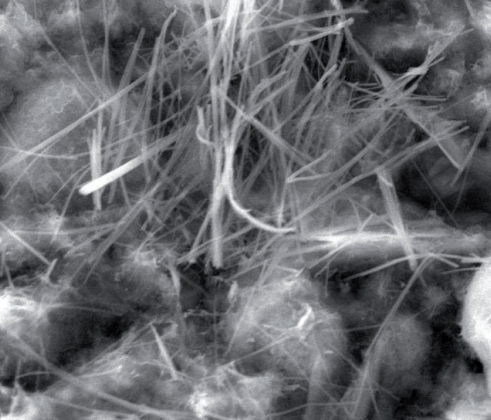
Mycelia grow exponentially to fill concrete micropores
One of the Bioconc microbes produces mycelia that grow exponentially until setting time, filling the concrete’s micropores — delivering the following 4 benefits.
Reference — Bioconc-Based Green Concrete Quality Treatment ↗ Reference — Optimum Concrete Compression Strength Using Bio-Enzyme (MATEC Web of Conferences, 2017): optimal Bioconc dosage 450–650 cc/m³ of concrete ↗Bioconc comes in three product variants
Bioconc improves concrete quality by refining the jobmix fractions: Bioconc mycelia “insert” into the concrete’s micropores, reducing cement and improving concrete watertightness.
The combined action of several Bioconc microbes produces three variants: Bioconc_07, Bioconc_08 and Bioconc_09.

Filling the gaps between aggregates while using cement more efficiently
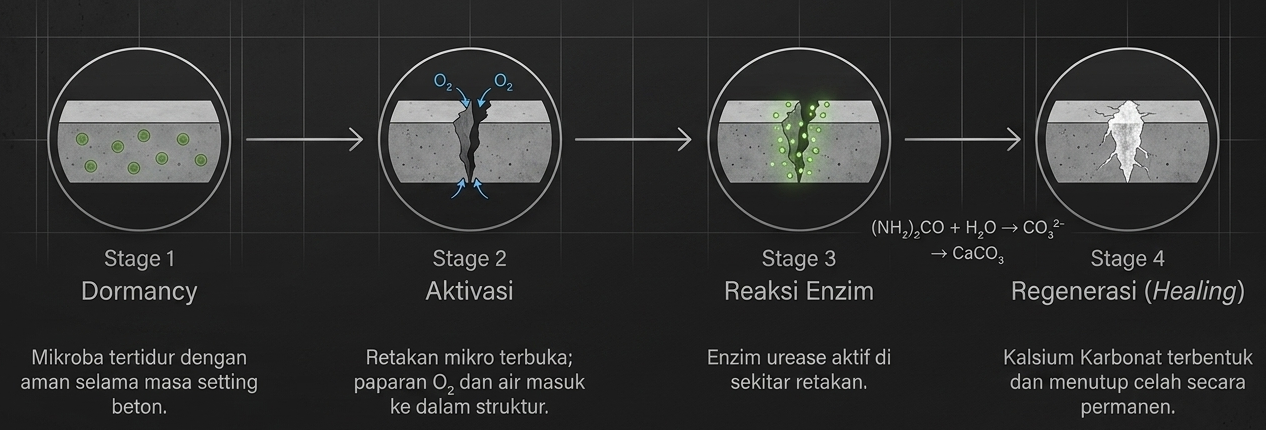
Bioconc improves concrete quality using Microbially Induced Carbonate Precipitation (MICP — Microbially Induced Carbonate Precipitation): an eco-friendly bio-mineralisation technique that improves concrete quality, addresses structural defects and provides self-healing properties (self healing concrete).
Bioconc increases compressive strength and reduces heat of hydration, producing Low Heat Concrete widely used in mass concrete pours (mass concreting), and delivers Self-Healing Concrete. This self-healing property is key to therecovery of shrinkage cracks (shrinkage crack) in concrete, improving its durability and service life.
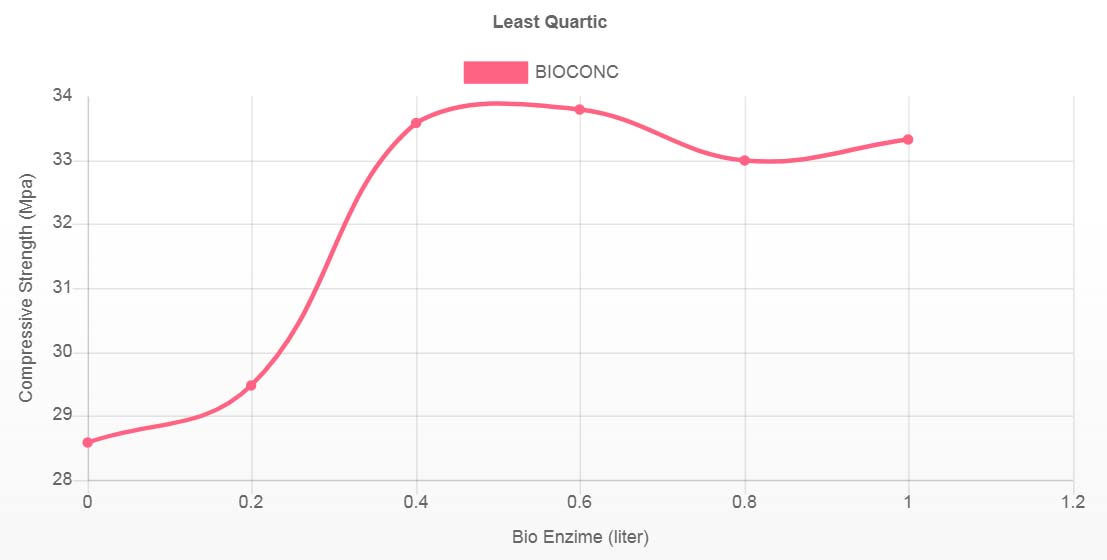
Optimum Concrete Compression Strength Using Bio-Enzyme — ResearchGate ↗
Bioconc Green Concrete Innovation
A solid black liquid (SG 1.25 kg/m³, pH 8.6) containing natural organics, denatured protein, biopolymer surfactant and organic minerals. Optimal dosage 500–600 cc per m³ of concrete.

See the impact on your jobmix
Simulate cement reduction, the new composition and production cost savings for the concrete grade you use.